


Avalance (Avax) Blockchain
Kassandra DAO
Kassandra DAO

Kassandra is on Avalanche
The Kassandra Protocol enables partnerships with quantitative investment funds, external data providers, and fund managers to create a diversified portfolio of investment products. We aim to be a truly decentralized fund manager without centralized leadership, and this means that is at our core the mission to be available and present wherever is possible in the crypto sphere.
What is Avalanche?
Avalanche is a fast-growing Layer 1 Proof-of-Stake blockchain and smart contracts platform. As a scalable chain, it can achieve a high number of transactions at a low cost, and in their own words: it’s blazingly fast and eco-friendly.
Kassandra Protocol
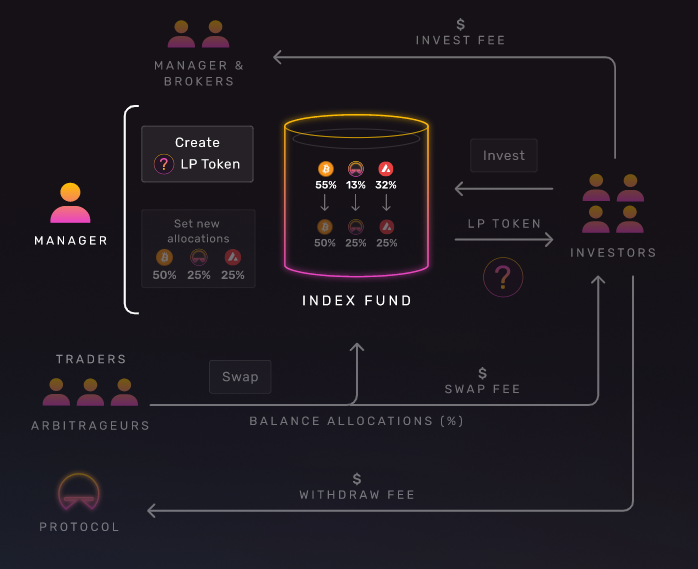
Kassandra is a decentralized autonomous organization that governs a set of tokenized data-driven investment funds, bringing a new class of investment products to the DeFi ecosystem: actively managed investment baskets without compromising the pillars of decentralization. All investment products made available through the Kassandra Protocol are permissionless, non-custodial, and actively managed by a third party.
The Kassandra Protocol allows partnerships with quantitative investment funds, external data providers, and fund managers to create a diversified portfolio of investment products, all managed by the Kassandra DAO.
The Kassandra DAO is controlled by the holders of the $KACY governance token, which is used to vote on proposals for protocol updates, to manage the existing investment products, and to create new products with new management strategies.
As for traditional fund managers, the Kassandra DAO benefits directly and indirectly from the success of the investment products deployed through the Kassandra Protocol.
Motivation
In the traditional market, exchange-tradable funds (ETFs) are investment funds that are traded directly on the stock exchange, where the index value is composed of the assets that the fund maintains in its portfolio. ETFs are a way to facilitate investor access to and exposure to a basket of assets while simplifying the operation by outsourcing management.
The development of decentralized financial products in the blockchain is a very recent field but experienced rapid growth in the last year with the popularization of many DeFi protocols. And despite recent progress, the notion of a financial product similar to an ETF done in a decentralized way is still new, but totally doable: creating a set of smart contracts on the blockchain that issue a redeemable token equivalent to a quota of a decentralized managed fund.
Currently, there are some protocols such as Index Coop, Indexed, Set Protocol that allow the creation of baskets of assets with a redeemable token that the value is represented by the assets that make up the basket. However, currently, no product has yet been developed that allows the creation of indexes based on strategies generated by data provided externally by a data provider, to carry out active asset management, nor the notion of a decentralized autonomous organization that curate and govern those investment products and accrue financial return through the success of these products.
As for Kassandra, we aim to build the first decentralized autonomous organization that works as a quantitative investment management organization for the cryptocurrency market, dedicated to producing returns for its investors by adhering to data-driven mathematical and statistical methods. Product will always come first, reliance on our products are key to attract and retain new users. We are very motivated and committed to bringing this vision to life.

DAO Deployment
The Kassandra Protocol is the core technology that allows the DAO to deploy investment products. It starts from the premise of building tokenized investment baskets that are permissionless, non-custodial, and actively managed, but yet monetary efficient.
Given an investment basket, it is necessary for the protocol that price changes of the underlying assets do not change the percentage shares of each asset in the basket, preserving the original participation weights of the assets. But being these investment baskets actively managed, it is also crucial that external data providers could change the asset allocations, giving new participation weights to each asset.
Smart Indexed Pools
As our first generalized approach to create tokenized investment baskets, we borrowed the design of Smart Indexed Pools (SIP) from Balancer Protocol and added oracle compatibility to allow active management from third-party data providers.
Under the hood, a SIP works essentially as an Automated Market Maker (AMM) for multiple assets, but with dynamically adjustable weights, that can be changed using external data. Using this approach removes the need for rebalancing operations by creating small arbitrage opportunities that external users can profit from and ensure that the desired proportions of each asset in the investment basket are maintained.
By making a monetary deposit in a SIP, the user will receive a deposit representative token, namely Index Token, that represents a fractional ownership of assets in the pool. The assets managed by the pool will have adjusted participations changed by the data provider, and at any time, the user can return his Index Token to the protocol to redeem his investment, which will be evaluated by the total value of the assets managed by the pool at the time of the redemption — functioning similar to a traditional market ETF.

The Firs SIP (Systematic Investment Plan)
For the development and launch of the first SIP, Kassandra partnered with the social data company for cryptocurrencies Heimdall, and will launch the first SIP and Index Token, namely $HEIM. The investment basket represented by this token will have its weights defined by the Social Score data provided by Heimdall, becoming a financial product that delivers exposure to the most socially active cryptocurrencies in the market.
Heimdall’s Social Score does not necessarily represent cryptocurrencies with the most social posts or the largest number of active users but rather represents an approximation of the network factor of the communities of these cryptocurrencies. For Heimdall, more important than how many are talking about a certain asset is who is it, so the Social Score can often be quite high even for projects that are not yet widely known, as long as those that socially interact with the projects have a lot of reach and social influence, in this way, the Social Score is often a pre-indication of a project that is becoming more popular.
Given a whitelist of tokens and currencies that can be invested, the composition asset strategy for SIP of $HEIM will be as follows:
The protocol will choose the ten tokens with the best social activity in the last 30 days, using Heimdall’s Social Scores, and make a weighted investment in each one, according to their respective social scores.
Frequently and smoothly, the protocol will use the new Social Score data to update the investment weights within the investment basket, and can even rotate the ten invested tokens with others available on the whitelist. For a more in-depth analysis and strategy, performance back tests, check out the document dedicated to the $HEIM token available on the Kassandra website.

Fees
The SIP is a generalized and dynamically adjustable AMM, any swap carried out through the pool is subject to a fee of 0.3% that goes directly to the portfolio holdings.
A 3% fee is implemented when redeeming any SIP token, which will be sent to a wallet under the control of the Kassandra DAO. The fees collected this way are under total governance control and can be used for the purchase and subsequent burn of the $KACY token.
As an additional rule, to flow value to the $KACY token holders, every SIP must hold at least 5% of the $KACY token as part of the portfolio. This holding percentage of the $KACY token ensures that the success of the SIPs will result in the growth of the $KACY token value.
Kassandra DAO & Token
The Kassandra Protocol enables partnerships with quantitative investment funds, external data providers, and fund managers to create a diversified portfolio of investment products. As Kassandra plans to be a truly decentralized fund manager without centralized leadership, we rely on creating a decentralized autonomous organization using a set of smart contracts to carry and execute decisions.
By creating a member-owned DAO through a governance token we plan to drive economic value from the financial products to the token holders, incentivizing all members to manage and deploy new investment products that grow the Kassandra ecosystem, with the token holders being committed to actively participating in crucial aspects to the success of Kassandra.
Having a functional and fully decentralized organization is one of the most important features of Kassandra, making it unique are the people connected behind the scenes. In a way, forking smart contracts and creating a new project is not a difficult task, but Kassandra goes beyond that. With a well-structured team focused to develop, deploy and manage data-driven trading strategies through decentralized mechanisms, we are ready to build a new paradigm of trustless fund management.
Kassandra Token
To act as a tool to assess decentralized decisions, Kassandra will have $KACY as its protocol governance token, which will be the intermediate for:
The approval and deployment of new code implementations and improvements;
The approval of new Index Tokens and their management;
Managing the rewards of the liquidity mining program;
Setting and changing parameters related to staking pools or Index Tokens;
Governing the DAO wallet and earnings from the financial products.
Any changes described above will necessarily need to be approved by a majority of the voting group, where $KACY could be staked to earn voting power.

Distribution
The initial and maximum supply of the governance token is 10,000,000 $KACY, which will be distributed as follows:
DAO & Rewards 46.5%: exclusive managed by DAO governance, which can be used to deploy capital to liquidity mining and staking rewards;
Foundation Reserves 20%: for future capitalization, reserve, development bounties, 6 months of lockup plus 18 months of linear vesting;
Seed Sales 5%: with 3 months of lockup plus 9 months of linear vesting;
Private Sale 10%: subject to 3 months of locking period and released in linear vesting in the next 9 months;
IDO 5%: in partnership with Penguin Finance, instantly released;
ILO 1%: offered at the launch of the token, it will remain in a lock for 6 months with custody of the foundation;
Team 12.5%: for founders and protocol development team, subject to 6 months of locking period and released in linear vesting in the next 18 months;
No other governance tokens will ever be created.
Governance and Staking
We relentlessly worked to design a governance and staking mechanism that could best represent and reward individuals that are fully committed to the future of Kassandra when participating in the governance process.
We chose to create our governance system around staking pools for the $KACY token that rewards the user with voting power, which will be used to vote on proposals to actively participate in the DAO. Those pools will have an optional parameter, named withdraw delay, which is the time the users will have to wait to remove the funds of the staking pool, counting from the moment after a withdraw from the staking is requested.
The withdrawal delay is a mechanism that rewards users that truly want to be involved with the Kassandra DAO decision process, that do not urge for liquidity when staking and have a long-term vision. More than that, this mechanism also drives $KACY market scarcity.
At the launch of Kassandra, the users can select from three options to receive voting power:
$KACY without withdrawal delay: 1 voting power per $KACY in staking;
$KACY with 15 days of withdrawal delay: 2 voting power per $KACY in staking;
$KACY with 45 days of withdrawal delay: 3 voting power per $KACY in staking;
The voting power of tokens in the current withdrawal period is reduced to 1 voting power per $KACY.
All those staking options, with different withdrawal delays and voting power multipliers, are initial configurations for the start and bootstrap of Kassandra, but none of them are definitive. In the following moments after the launch of Kassandra the community can choose to change those parameters and pool options, in a way to better represent the interests of Kassandra.
For factual governance, proposals will have two voting options: favorable or against. For a proposal to be considered valid, it must accumulate 4% of the total voting power in the sum of the two voting options, otherwise, the proposal is rejected due to the lack of a representative choir. For a proposal to be approved, there must be more voting power in favor than against, otherwise, the proposal is rejected by majority decision.
To create a proposal that the community will vote on, the portfolio that issues the proposal must have more than 1% of the total voting power.

Liquidity Mining and Staking Rewards
To create a fully decentralized organization, with a well-distributed token, we chose to have a big part of the total supply (46.5%) slowly available through rewards for $KACY and Index Tokens stake, rewarding people that engage and help Kassandra in the early stages. At launch, we chose to reward three different staking options.
First, the staking of $KACY for governance porpuses in all the staking pool options. These staking rewards will reward users that plan to hold $KACY in the long term, achieving a good yield while keeping tokens locked outside the markets.
Second, we chose to reward users that stake our first Index Token, namely $aHYPE. With this, we encourage users to mint and stake the first Kassandra product, promoting the popularity and market growth of our first trading strategy while increasing the financial value managed by Kassandra.
Third and last, we will be rewarding those who provide liquidity for the $KACY token at Pangolin or TraderJoe, through the stake of the $KACY/AVAX LP token.
At launch, we defined that for the first 3 months 400,000 $KACY will be released linearly at a rate of ~4,444 $KACY per day, with the distribution plans as follows:
1,111 $KACY day to the staking of the Index Token $aHYPE;
1,667 $KACY day to the staking of PNG or JOE $KACY/AVAX LP token;
278 $KACY day to the staking of $KACY without withdrawal delay;
556 $KACY day to the staking of $KACY with 15 days of withdrawal delay;
833 $KACY day to the staking of $KACY with 45 days of withdrawal delay;
Reviews & Ratings
Rate the Project


