


Ampleforth

Introduction
The Ampleforth protocol is a set of instructions on the Ethereum blockchain that produces a decentralized unit of account called AMPL. The AMPL token is the primary building block of the Ampleforth Elastic Finance Ecosystem. It is used for lending & borrowing, for the creation of derivatives, and as collateral for a decentralized stablecoin.
AMPL and FORTH
The protocol consists of two primary tokens, AMPL and FORTH.
1. AMPL: The unit of account ERC-20 token. AMPL's price targets the CPI adjusted 2019 USD, but the number of AMPL tokens in user wallets automatically increases or decreases based on demand. AMPL will deviate from its target when market demand indicates there is too much or too little supply, but the price per AMPL will always eventually return to its long-run target.
2. FORTH: The Ampleforth ecosystem's governance token. FORTH is an ERC-20 token used to govern protocol parameter changes, direct liquidity mining emissions, and direct the use of DAO treasury assets dedicated to stimulating innovations in the elastic finance and broader DeFi space. Holders vote using their FORTH tokens.
How the Ampleforth Protocol Works
The Ampleforth Protocol targets the CPI adjusted 2019 US dollar and automatically expands or contracts the quantity of tokens in user wallets based on price. Think of AMPL as similar to Bitcoin, except the number of AMPL tokens in your wallet increases when there's more demand and decreases when there's less demand.

Elastic Supply Policy
Expansion: When the price_exchange_rate of AMPL > 1 2019 USD the market is indicating there is more demand than supply. In response the Ampleforth protocol automatically and proportionally increases the quantity of tokens in user wallets, gradually bringing price down to its target.
Contraction: When the price_exchange_rate of AMPL is < 1 2019 USD the market is indicating there is more supply than demand. In response the Ampleforth protocol automatically and proportionally decreases the quantity of tokens in user wallets, gradually bringing price up to its target.
AMPL will deviate from its target when market demand indicates there is too much or too little supply, but the price per AMPL will always eventually return to the CPI adjusted 2019 dollar. Holders of the AMPL token experience supply volatility, but contracts denominated using AMPL remain stable in the long-run.
Because the Ampleforth protocol transfers the volatility of demand rather than attempting eliminate it altogether, AMPL cannot break by natural market forces and does not require any collateral, treasury, market-maker, or buyer-of-last-resort to return to its long-run target.
Thinking Fast and Slow
The Ampleforth protocol establishes a set of initial conditions and incentives for the network. There is no centralized oversight of price or supply in the Ampleforth protocol. Rather, it depends on a decentralized
network of actors.
While the protocol propagates price information into supply, it’s the actors that propagate supply information back into price.
Recall that the Ampleforth protocol programmatically sets equilibrium supply targets, which is important because the promise of elastic supply needs to be strictly enforced. However changing supply does not mean that actors will correspondingly adjust their bids, nor will they do so in unison. Instead, actors will respond to supply changes based on how quickly or slowly they think others will respond.

Volatility Fingerprint
By adjusting supply in response to demand, the Ampleforth protocol applies a countercyclical pressure that is not present in current-generation digital assets.
For this reason, it’s natural to ask whether Ample prices will move differently from other synthetic commodities. Below, we suggest that the movement pattern or volatility fingerprint generated by the Ampleforth protocol will eventually have:
• A step-function-like market cap curve that alternates between dynamic states and equilibrium states
• A price curve that trades around the exchange rate target, with deviation during dynamic periods
To understand the potential behavior of Amples, we start by examining the proxies for gain and loss presented by the Ampleforth protocol that do not exist in other synthetic commodities. How actors respond to these will determine the movement pattern of Amples’ price and supply.
What's New
Unlike current-generation synthetics, value changes in the Ampleforth network can be attributed to supply in addition to price. Thus both the supply of units, S, and the price per unit, P, should be taken into consid-
eration. The combination of these two signals can be represented by market cap, M, where M = P × S.
The Ampleforth supply policy has three states:
Expansion
Contraction
Equilibrium
1. Expansion
During expansion there is a window in time where fast actors have an opportunity to sell after the supply increases but before any price correction occurs. As long as there are enough fast actors willing to sell, price will decrease. This could produce price and supply patterns like those below:
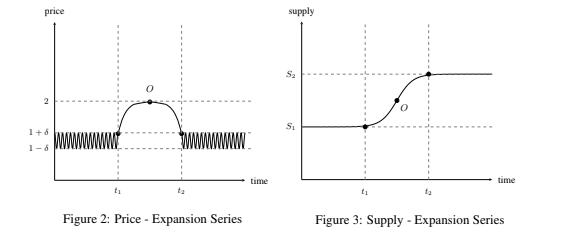
As shown above, the price series P (left) could end roughly as it begins; however the corresponding supply series S (right) would end higher than where it began.
To best evaluate the unique gain and loss relationship created, we examine the M = P × S or market cap series below:
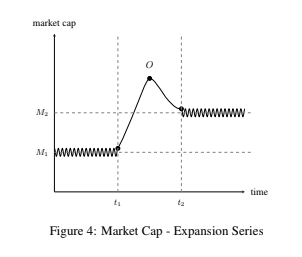
Looking at M above, fast actors will see that, while t1 < t < t2, there is an opportunity to sell more Amples at a higher price than at the next equilibrium point M2. This occurs because the system expands proportion-
ally to holders when the nominal exchange rate of Amples is > the price target threshold, and continues to expand daily until the price target returns.
An actor looking only at price cannot differentiate between selling at t < O and t > O, because by all appearances the price series chart is symmetric. In contrast, an actor looking at P × S sees an asymmetric opportunity, and can capitalize on it.
2. Contraction
The activity on contraction is similar. As long as enough actors value the opportunity to buy more of the network for a cheaper price, price would correct upward and creating general price and supply patterns like:
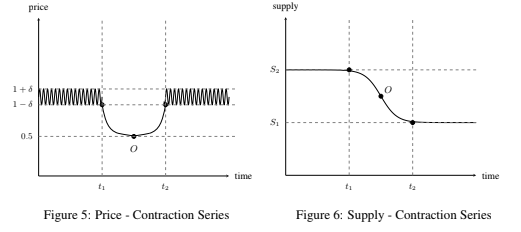
Again in this case the price series (left) appears to end roughly as it begins; whereas the corresponding supply series (right) paints a different picture, ending lower than where it began. To evaluate the market dynamic created, we can similarly look at the M = P × S or market cap series below:
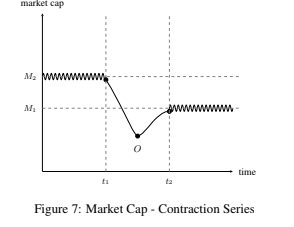
Looking at M above, fast actors will see that, while the system is contracting between t1 < t < t2, there is an opportunity to buy more Amples at a lower price than at the next equilibrium point M1. This occurs because the system contracts proportionally from holders when the nominal exchange rate of Amples is < the price target threshold, and continues to contract daily until the price target returns.
Similar to the expansion case, an actor looking only at price cannot differentiate between buying at t < O and t > O, because the price series chart is symmetric. In contrast, an actor looking at P × S sees an
asymmetric opportunity, and can capitalize on it.
3. Equilibrium
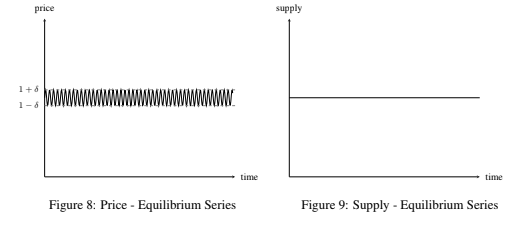
Within the threshold band of the price target the supply policy does not intervene and supply remains constant. This would generate a price and supply pattern like below:
Predicted Output
Combining all these together suggests a potential price and supply movement pattern like below:

Price (above left) could remain around a certain exchange-rate, deviating during dynamic (dotted) periods.
However, market cap could look like a step-function, alternating between dynamic (dotted) states and equilibrium states:

In practice, the time to exit a dynamic state is market dependent and may take multiple supply adjustment cycles to complete. Fast actors will therefore have an opportunity to act in each of these cycles. The Ampleforth team expects that actors will attempt to predict where the next equilibrium market cap will land, derive their buy and sell targets from these predictions, and update targets as the market discovers its actual equilibrium point.
Tracking Ampleforth
The Ampleforth Ecosystem is a decentralized finance infrastructure powering innovations in money. Ampleforth develops and supports the use of foundational building blocks for a new digital economy through its unit of account protocol AMPL, its DAO governance protocol FORTH, and its upcoming inflation-resistant stablecoin protocol.
Ampleforth
Ethereum (ETH) Blockchain
Reviews & Ratings
Rate the Project


