


Basic Attention Token (BAT)
Introduction
Digital advertising is broken. The marketplace for online advertising, once dominated by advertisers, publishers and users, has become overrun by “middleman” ad exchanges, audience segmentation, complicated behavioral and cross-device user tracking, and opaque cross-party sharing through data management platforms. Users face unprecedented levels of malvertisements and privacy violations. Mobile advertising results in as much as $23 per month in data charges on the average user’s data plan, slow page loads, and as much as 21% less battery life. In response, over 600 million mobile devices and desktops (globally) employ ad blocking software and this number is growing. Traditional publishers have lost approximately 66% of their revenue over the past decade, adjusted for inflation. Publishers face falling revenue, users feel increasingly violated, and advertisers’ ability to assess effectiveness is diminished. The solution is a decentralized, transparent digital ad exchange based on Blockchain.
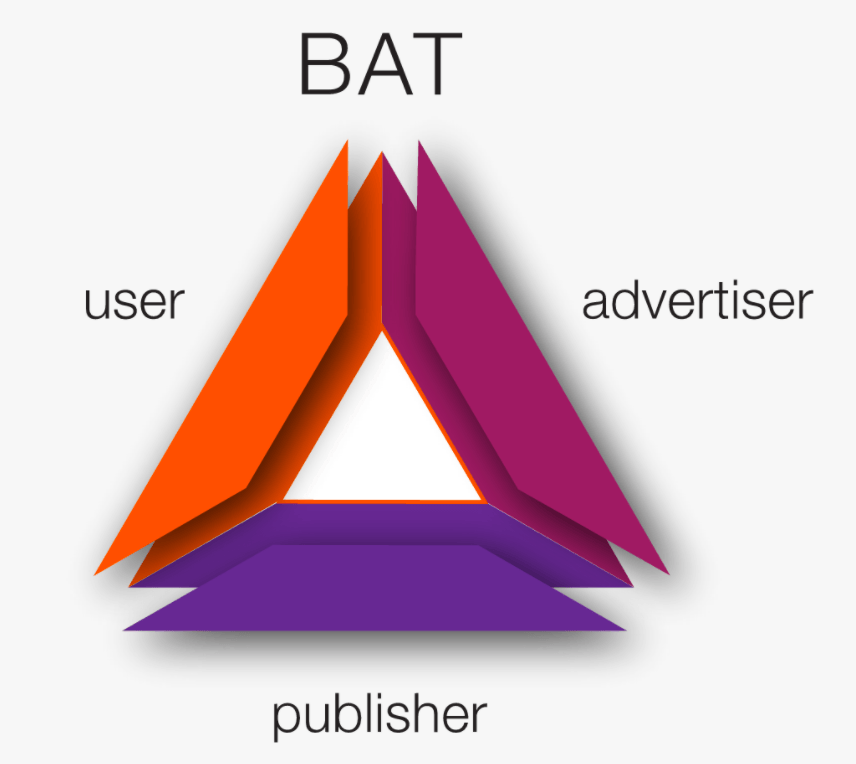
The first component is Brave, a fast, open source, privacy-focused browser that blocks third party ads and trackers, and builds in a ledger system that measures user attention to reward publishers accordingly. Brave will now introduce BAT (Basic Attention Token), a token for a decentralized ad exchange. It compensates the browser user for attention while protecting privacy. BAT connects advertisers, publishers, and users and is denominated by relevant user attention, while removing social and economic costs associated with existing ad networks, e.g., fraud, privacy violations, and malvertising. BAT is a payment system that rewards and protects the user while giving better conversion to advertisers and higher yield to publishers. We see BAT and associated technologies as a future part of web standards, solving the important problem of monetizing publisher content while protecting user privacy.

The reality remains: user attention is valuable, but it hasn’t been properly priced with an efficient and transparent market system. While it has become a platitude that vast amounts of information are generated on and by the Internet, human beings are only able to devote a limited amount of attention to certain small subsets of the information. Information in the modern age is relatively cheap. Human attention paid to the information is the rare quantity. As Herbert Simon put it in an influential 1971 article: “...in an information-rich world, the wealth of information means a dearth of something else: a scarcity of whatever it is that information consumes. What information consumes is rather obvious: it consumes the attention of its recipients. Hence a wealth of information creates a poverty of attention and a need to allocate that attention efficiently among the overabundance of information sources that might consume it.”
Token Technology
The Basic Attention Token (BAT), a token based on Ethereum, is an important element of a new marketplace. Ethereum is an open source, blockchain-based, distributed computing platform oriented towards smart contracts. Effectively, Ethereum is a distributed virtual machine that allows end users to construct smart contracts for transactions. Smart contracts are stateful applications stored in the Ethereum blockchain. These contracts are cryptographically secure and can verify or enforce performance of the contract. Token contracts are a standard feature of the Ethereum ecosystem.
Ethereum has been used for mobile payment systems, distributed exchanges, tokens pegged to commodities and fiat currencies, market clearing mechanisms, micropayment systems for distributed computing resources, commodities and securities exchanges, crowdfunding, and legal document verification. Large firms have invested in and deployed Ethereum, with JP Morgan, Deloitte, IBM, Santander Bank, Microsoft, the Luxembourg Stock Exchange, and the Royal Bank of Scotland being key early adopters.
Micropayments using BAT will be accomplished for the first stage deployment with the Brave Micropayments Ledger. Each viewed ad will be verified at the browser using the BAM. This flow shows the conceptual flow of the BAT payments. The flow of the BAT payments will not follow this chart precisely in first iterations of the BAT payment system as the payments will be regulated by the Brave ledger system, but the total effect will be the same. The high-level concept is the advertiser sends a payment in token along with ads to users in a locked state Xa.
As the users view the ads, the f low of payments unlocks, keeping part of the payment for their own wallet (Xu), and passing on shares of the payment to Brave (Xb) and passing the remainder on to the Publisher (Xa-Xu-Xb). The BAT will, in early stages, be specifically tied to Brave browsers and Brave servers, along with verified publishers. Ad fraud will be prevented or reduced by publication of source code and cryptographically secure transactions. Ads served to individual browser/users will also be rate-limited and tied to active windows and tabs. Payments in BAT will be sent only to publishers, though a payment for viewing an ad on one publisher may be used at another publisher or kept for some other premium services supplied through the BAT system.
Tokens Used as Publisher Payment
Publisher payment will be through the BAT system. For the first deployment of BAT, the transactions in BAT will take place through the Brave Ledger system, which is an open source Zero Knowledge Proof scheme presently deployed to allow Brave users to make anonymous donations to publishers using bitcoin as the medium of exchange. The Brave Ledger system uses the ANONIZE algorithm to protect user privacy. For the first incarnation of BAT, all payments in BAT must have a publisher endpoint.
The “concave” awarding mechanism calculates an attention score based on a fixed threshold value for opening and viewing the page for a minimum of 25 seconds, and a bounded score for the amount of time spent on the page. A synopsis of user behavior is then sent back to the Brave Ledger System for recording and payments made on the basis of the scores. Much of the infrastructure required to deploy BAT at the back end is presently code complete, in place and being used to distribute donations based on user attention. As such, this infrastructure will be leveraged to deploy BAT as soon as possible for testing, user, and advertiser feedback. A fully distributed ledger is desirable, both for public accountability and potential scalability reasons.
Publishers, advertisers and users of the BAT token will have incentive to use such a system to keep track of payments within the BAT system. State channels allow for multiple small transactions with strong anonymity guarantees when using the correct matching algorithms. While Raiden and other state channel schemes are becoming integrated with the Ethereum ecosystem, and new blockchains such as Zcash and Monero offer stronger privacy guarantees with rapidly increasing feature sets, it is likely that a new scheme addressing the unique problems of this type of transaction will be used for large scale multiparty transfer of BAT.

A lottery system may be used, where small payments are made probabilistically, with payments happening essentially in the same way that coin mining works with proof of attention instead of proof of work, BOLT, Zero Knowledge SNARKor STARK algorithms may become part of this stack for guarding privacy of participants.
The BAT situation is mitigated by the fact that the privacy of the browser customer is of primary importance; publishers and advertisers have fewer privacy concerns. The transactions in a fully distributed BAT system will almost always be one to many and many to one, therefore novel zero-knowledge transactions may be suggested by this arrangement. As Brave moves to a fully distributed micropayment system, we expect other developers to use our free and open source infrastructure to develop their own use cases for BAT. We want BAT and the tools associated with it to eventually become important web standards for future development of web content. Publishers, advertisers and users who view web content deserve a private, secure and well-engineered future.

Tokens for User Applications
As users are given access to some of the advertising spend in BAT, they will become an important and active part of the advertising and publishing economy, rather than the passive participants they are presently treated as. While tokens can be donated to individual content providers and publishers, there are any number of use cases for the tokens. An obvious use case is for very specific targeted advertising. Many small businesses have modest requirements which may be well served by tokens they acquire through their normal browsing activities. Users may also find new uses with low barrier to entry highly targeted ads; personal ads targeting people of a religion or subculture for example.
Some publishers may have premium content they would ordinarily only offer to subscribers. Since subscription models are not typically favored by users on the internet, this could unlock new revenue for premium content providers. Content may also be bought for friends using the token; if someone likes a premium article, they can make a micropayment to send it to three of their friends. Higher quality content may also be offered to users for a BAT transaction. For example, higher quality video or audio on an entertainment channel, or some kind of summary of headlines in a news source. Video or audio content in a news or other information source may be restricted to people who pay a small micropayment. Comments may be ranked or voted on using BAT tokens, similar to the “thumbsup/thumbsdown” on some comment sections. Comment votes backed by BAT may be given more credibility due to the fact that someone cared enough to back the comment with what would be a limited supply of token, as well as the fact that a token transfer can be verified as coming from real people rather than robots.
The right to post comments may also be purchased for some minimal payment, to cut down on abusive commenters. Eventually, BAT may be used within the Brave ecosystem to purchase digital goods such as high resolution photos, data services, or publisher applications which are only needed on a one-time basis. Many publishers have access to interesting data sets and tools which they are not able to monetize on a subscription basis, but which individuals may wish to occasionally use. For example, firms such as Pro Publica, Citzen Audit and Gartner contain interesting public data and premium content, but many individuals f ind a subscription too costly. Small parts of news archives may also be of interest to people who do not want to purchase access or a subscription to the entire archive.
BAT may also be used in games provided by publishers within the Brave ecosystem. While such applications are not presently popular with publishers, many platform providers have hosted profitable gaming applications. It could create a new economy of app creators to go along with content. For example, ’punch the political/entertainment figure’ games to go along with critical articles. People won’t get out their credit card to use such an application, but they may be willing to part with some value they acquired in normal browsing activities to enjoy punching their favorite entertainment figure. Custom newsalerts may be offered as a service by news providers for a small payment of BAT within the ecosystem. Such news alerts may be very valuable to individuals who are concerned with current events, financial news or some anticipated event.
Tracking BAT
Crypto and DeFi are hard to use and the $330 billion digital advertising industry is failing users, publishers and advertisers. With Basic Attention Token and Brave we want to take Crypto to the next 1B users and solve the endemic inefficiencies and privacy violations hobbling the digital ad industry.