


Avalance (Avax) Cripto Blockchain
Olympus DAO

What is Olympus?
The goal of the Olympus protocol is to create a decentralized, censorship resistant reserve currency for the emerging Web3 ecosystem. Developing a reserve currency is important because a fundamental goal of the Web3 financial movement is to foster an alternative economic ecosystem that serves the needs of its various stakeholders, which include:
Having access to unique purpose-built assets that are widely and uniformly available across L1s and L2s
Being able to transact/store value in highly decentralized and censorship-resistant assets that are not dependent on the traditional financial ecosystem for validation or survival
Note: for those who have not read the complete overview for L1 and L2 in KeyWord Financials' Education section...please read and watch the following...
What is L1 and L2 in Crypto?
In the decentralized ecosystem, a Layer-1 network refers to a blockchain, while a Layer-2 protocol is a third-party integration that can be used in conjunction with a Layer-1 blockchain.
What is OHM?
Olympus’ goal is to create a credibly neutral currency for Web3 and to help onboard users into a decentralized, democratized economy, with the additional goal of becoming the reserve currency for DeFi.
What are reserve currencies designed to achieve? Preserving purchasing power: Over the medium- to long-term the asset grows to out-pace inflation, and becomes more stable over time
Deep liquidity: Reserve currencies are highly liquid and can be easily exchanged for other assets, products and services
Utilized as a unit of account: Other assets are denominated in the currency
Reserve assets serve as trusted backing: The currency is viewed as reliable and relatively low risk, which encourages entities to hold large quantities of it in reserve
Currently, Olympus is early on its journey to secure OHM’s status as a decentralized reserve currency. The Olympus12 Action Plan outlines the concrete steps the DAO is taking to make this vision a reality in 2022, including making OHM as automated and governance-minimized as possible.
Why is there a need for a reserve currency in DeFi?
In contrast to the incumbent fiat system that’s declining in value due to inflation, our goal is to build and retain real purchasing power that withstands the test of time. Olympus DAO’s efforts in Treasury management, development of on-chain governance structures and prudent use of Olympus’ liquidity and Treasury assets will help to strengthen OHM’s stability.
How does Olympus operate?
Olympus is run by OlympusDAO.
OlympusDAO is a network of dedicated community members who execute on decisions & protocol mechanisms voted on through community governance. The eventual goal is to build an autonomous system at the protocol level, in which the behavior of OHM is largely influenced by decentralized smart contracts and with minimal human intervention.
The DAO is pursuing a strategy of “progressive decentralization.” Currently, major components of the protocol are controlled at a high-level by the DAO. Though, ultimately the focus is on creating a foundation at the Treasury, Policy and economic levels, and to enable the community to directly operate protocol mechanics – in a trust- and process-minimized fashion.

Governance
All proposals, whether being consistent with the general direction of the DAO, a change in policy, or a pivot to a certain strategy or framework are voted for by the community. Any member of the community can create a proposal on the forum for discussion before being posted to snapshot for a governance vote.
Olympus Governance Council (OGC) will be initially comprised of 7 veteran community members who are primarily responsible for facilitating off-chain processes. These can include, but are not limited to, establishing strategic vision, coordinating working groups to execute on community-approved initiatives, and proposing strategic initiatives to the community via OIP.
Key deliverables for the OGC include:
Drive prioritization and alignment across the DAO departments and working groups
Chart a path to further decentralized DAO governance and operations
Oversee the broader econOHMy
Staking
Staking is the primary value accrual strategy of Olympus. Stakers stake their OHM on the Olympus website to earn rebase rewards. The rebase rewards are minted every 2200 Ethereum blocks (8 hours) as long as there is a corresponding equivalent of 1 DAI in the Treasury to back it. This is guaranteed on the smart-contract level.
Runway displays the number of days Olympus would maintain its current rate of emissions without any inflows to the Treasury or changes to the reward rate. Staking is a passive, long-term strategy. The increase in your stake of OHM translates into a constantly falling cost basis converging on zero. This means even if the market price of OHM drops below your initial purchase price, given a long enough staking period, the increase in your staked OHM balance should eventually outpace the fall in price.
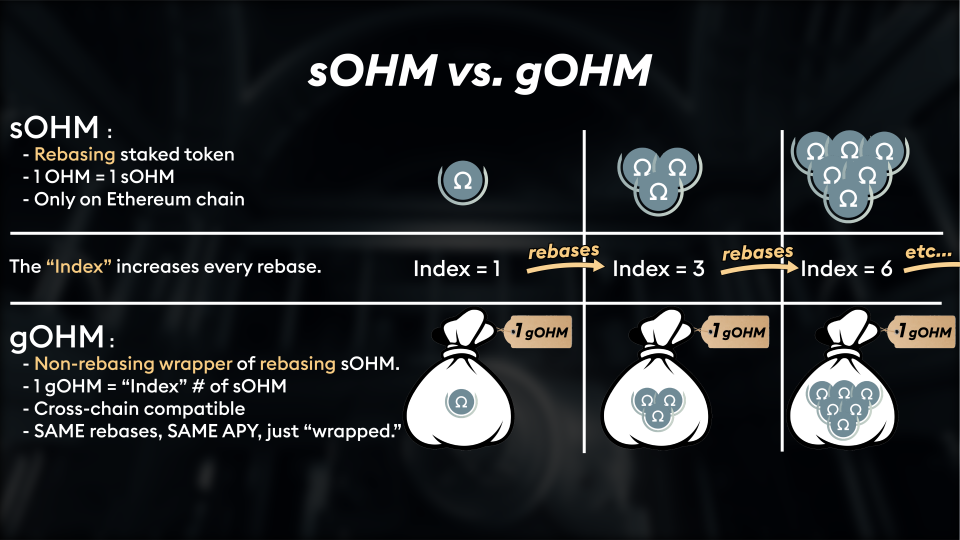
When you stake, you lock OHM and receive an equal amount of sOHM. Your sOHM balance rebases up automatically at the end of every epoch. sOHM is transferable and therefore composable with other DeFi protocols.
When you unstake, you burn sOHM and receive an equal amount of OHM. Unstaking means the user will forfeit the upcoming rebase reward. Note that the forfeited reward is only applicable to the unstaked amount; the remaining staked OHM (if any) will continue to receive rebase rewards.
What is the benefit of staking OHM?
By staking their OHM, users opt in to actively participate in the Olympus network, and become eligible participants in governance. By participating in the network, stakers benefit from a rebasing mechanism that ensures their position scales with OHM emissions and overall the growth of the network.
Every 8 Hours (2200 Ethereum Blocks) the protocol uses two mathematical formulas to calculate the network wide distribution.
##What is the relationship between staking and reward rate?
The level of OHM staking rewards is determined by the overall reward rate, and was codified by the community (via the OIP-18 vote). The reward yield, which is a function of reward rate, is also dependent on how many other individuals are staking their OHM. When more individuals are staking the reward yield declines and the opposite occurs when the reward rate increases.
Olympus presents our current sOHM (staked OHM) reward yield as an illustrative annual percentage yield (APY) on our app. We do this because sOHM rebases several times a day (about every 8 hours). Given this, rebases have an effect analogous to compounding interest.
The APYs presented by Olympus are a representation of the current rebase rate, number of stakers and existing supply. These calculations are floating and the current rates are not a guarantee of future returns.

Bonding
Olympus bonds are a financial primitive for protocols to acquire assets, including their own liquidity, in exchange for governance tokens at a discount. In other words, Olympus bonds are a pricing mechanism for any two ERC-20 tokens that does not rely on third parties like oracles. Olympus bonds internally respond to supply and demand by offering a variable ROI rate to the market and its users.
How do both the Olympus Treasury and the bonder benefit from the process?
Bonds are the primary mechanism for Treasury inflows, and thus, the growth of the network.
Bonders commit a capital sum upfront and are promised a fixed return at a set point in time; that return is in OHM and thus the bonder's profit would depend on OHM price when the bond matures. In Olympus v2, users who bond their assets for OHM reap the same benefits as stakers as OHM is automatically staked at the time of a bond purchase.
If the ROI is positive – a bond can be purchased at a discount to market price) – market participants (bonders) are incentivized to exchange their assets for gOHM, vested over a period of time. The Treasury sells OHM at a premium to its backing, while the bonder is able to capture a discount (positive ROI) by purchasing OHM directly from the Treasury. However, if the variable ROI is negative, and market participants are unable to express their demand on the bond marketplace, they would have to resort to a decentralized exchange.
The variable ROI rate is at the one hand determined by the demand for the given bond on the Olympus bond marketplace, and on the other hand it is governed by the policy team which sets the BCV which determines the bond capacity. In exchange for being temporarily illiquid, and exposed to OHM/gOHM volatility for the duration of the vesting period, the bonder is rewarded with a variable ROI rate.

Treasury
For Olympus, the Treasury is a key function of the protocol. The Treasury represents all assets owned and controlled by the protocol. This is also known as Protocol Controlled Value (PCV). The Treasury defines a few internal classifications, and all of them combined represent the budget for various market operations, or the ability to influence OHM.
Treasury Reserves, represented per token as liquid backing, this represents a total budget Olympus has for various market operations.
Protocol owned liquidity – Deep liquidity is one of the central pillars that make a reserve currency. Liquidity owned by the protocol is a guarantee a liquid market facilitating exchange in both directions exists.
Locked, vesting, or other strategic assets
Protocol-owned liquidity (POL)
The concept of POL is an attempt to solve bootstrapping liquidity while avoiding the cost of paying self-interested external liquidity providers – mercenary capital. Rather than renting, Olympus owns its own liquidity.
Without being reliant on external liquidity providers, Olympus can guarantee a liquid market for OHM while establishing a revenue stream from LP fees for the Treasury.
All protocol liquidity adds towards OHM backing – the LP tokens are marked down to their risk-free value for this purpose. You can read more about the rationale behind here.
While Olympus’ POL will always remain crucial to its goal of being a reserve currency, as it matures it will be equally as important to have other market participants who share aligned interests help to make OHM more easily accessible across different exchanges and platforms.
Olympus Pro
Olympus Pro is a bond marketplace for protocol owned liquidity. When users purchase Bonds through Olympus Pro, it allows Protocols to accumulate liquidity to secure longevity and price stability for everyone involved. This makes bonds a mutually beneficial exchange.
Olympus Pro can be a tool for our partner DAOs to pursue other strategies, because Olympus Pro can be used to exchange any two different assets.
Incubator
Olympus Incubator is an initiative to help foster the growth of the Olympus economy, providing value:
community bootstrapping
exposure and promotion
advice and assistance
early funding
access to our launch and liquidity products
early usage of a protocol by Ohmies
Stake Your OHM
Staking allows you to earn OHM passively via auto-compounding. By staking your OHM with OlympusDAO, you receive sOHM (staked OHM) in return at a 1:1 ratio. After that, your sOHM balance will increase automatically on every epoch based on the current APY.
How to Stake
Go to the Stake page of the OlympusDAO website. Select the "Stake" tab.
Enter the amount of OHM that you would like to stake in the input field. If you would like to stake all your OHM, press the "Max" button and the input field will be populated with all your available OHM balance.
Click "Approve" and sign the transaction.
After the "Approve" transaction has been processed successfully, click "Stake" and sign the transaction. Voila, you have staked your OHM!
How to Unstake
Go to the Stake page of the OlympusDAO website. Select the "Unstake" tab.
Enter the amount of sOHM that you would like to unstake in the input field. If you would like to unstake all your sOHM, press the "Max" button and the input field will be populated with all your available sOHM balance.
Click "Approve" and sign the transaction.
After the "Approve" transaction has been processed successfully, click "Unstake" and sign the transaction.
Note: The "Approve" transaction is only needed when staking/unstaking for the first time; subsequent staking/unstaking only requires you to perform the "Stake" or "Unstake" transaction.

Annual Percentage Yield (APY)
tells you the annualized rate of return based on the reward yield. It takes into account the effect of compounding since sOHM rebases exponentially.
Total Locked Value (TVL)
measures the dollar amount of all the staked OHM in Olympus.
Current Index
allows you to track your gain from staking. The index started from 1 at epoch 0, and increases every epoch. If you staked at genesis (epoch 0) and never unstaked any OHM, your balance today would be X times greater, where X is the current index. You can use the index to track your position by marking down the index number when you stake and unstake. You divide the index number when you unstake by the index number when you stake to get the ratio by which your sOHM balance has increased.
Your Balance
tells you how many unstaked OHM are in your wallet. This is the maximum amount that you can stake.
Your Staked Balance
tells you how many staked OHM are in your wallet. This is the maximum amount that you can unstake.
Next Rebase
tells you the remaining time until the next rebase.
Reward Yield
tells you how much your sOHM balance will increase when the next epoch begins. For example, if you stake 100 OHM and the upcoming rebase is 0.5427%, your sOHM balance would increase from 100 to 100.5427.
Return On Investment (ROI)
(5-Day Rate) estimates how much your sOHM balance will increase after 5 days, if the reward yield stays the same during this period. For example, if you stake 100 OHM and the rate is 8.4577%, your sOHM balance would increase from 100 to 108.4577 after 5 days.